Research研究
Four directions, one question. 四个方向,一个问题。
We study how visual models learn, adapt and use representations: what should stay stable when inputs change, how little supervision or adaptation is enough, and how representations can serve recognition, generation and multi-modal perception.
我们研究视觉模型如何学习、适配与使用表征:输入变化时什么应当保持稳定,多少监督或适配才足够,以及表征如何服务于识别、生成与多模态感知。
Directions研究方向
Learning more from less. 以更少,学更多。
The shared question: how can visual models learn useful structure from fewer labels, fewer parameters, and partial or heterogeneous views?
共同的问题是:视觉模型如何用更少的标签、更少的参数,以及不完整或异构的视角,学到有用的结构?
Self-supervised representation learning 自监督表征学习
Labels are expensive, so we ask what a self-supervised learner actually needs. CORE removes the components of a contrastive learner that turn out not to matter and comes out cheaper and more accurate; SDI replaces random corruption with semantic-guided augmentation built on foundation-model priors; DAGA asks what a frozen self-supervised backbone can be adapted into. The thread is label efficiency: how little supervision is enough?
标签昂贵,因此我们追问自监督学习器究竟需要什么。CORE 去掉对比学习中并不必要的组件,反而更省、更准;SDI 以基础模型先验驱动的语义引导增广取代随机破坏;DAGA 研究冻结的自监督骨干可以被适配成什么。贯穿其间的是标签效率:多少监督才足够?
CORE & SDI papersCORE 与 SDI 论文Efficient adaptation & transfer 高效适配与迁移
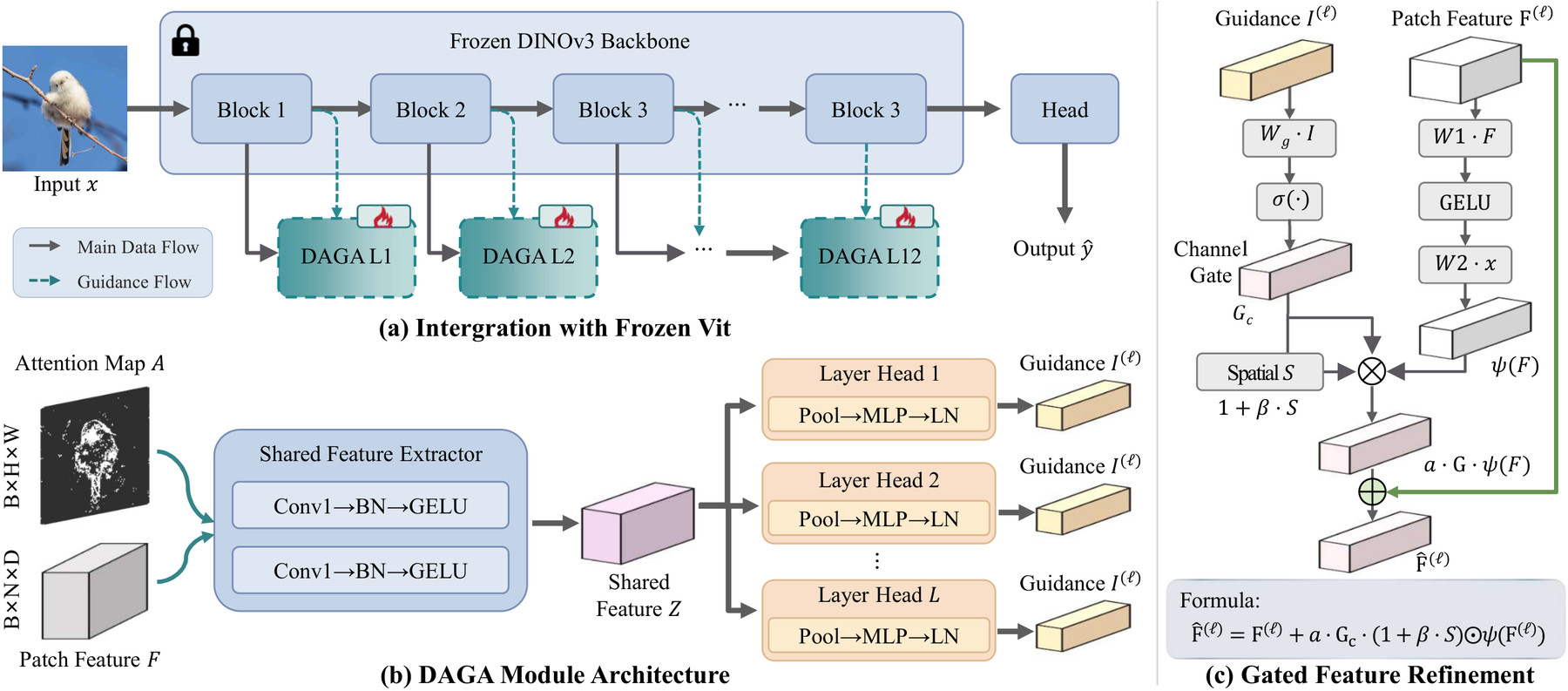
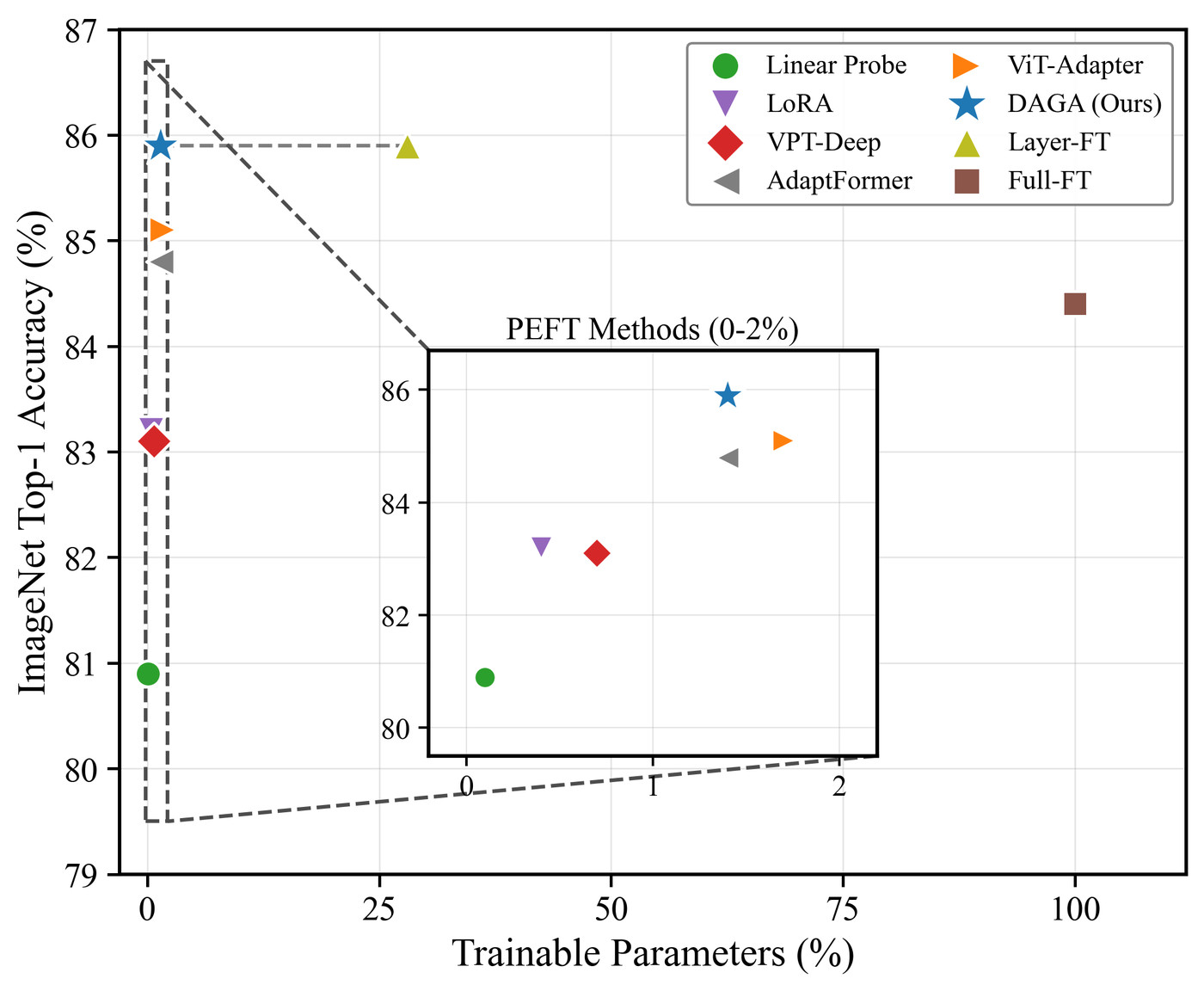
Adapting a frozen foundation model should not mean retraining it. DAGA turns a backbone's own attention into in-loop guidance for lightweight feature refinement: with a frozen DINOv3-ViT-B it reaches 85.9% ImageNet-1K top-1 while training 1.4% of the parameters, matching layer-wise fine-tuning at 18× fewer trained parameters and improving ADE20K by +2.9 mIoU over the best-tuned static-gating PEFT. We care about the whole trade-off curve between accuracy, parameters and labels.
适配冻结的基础模型,不应意味着重新训练。DAGA 把骨干自身的注意力变成轻量特征细化的闭环引导:在冻结的 DINOv3-ViT-B 上取得 85.9% 的 ImageNet-1K top-1,仅训练 1.4% 的参数,以少 18 倍的可训练参数量与逐层微调持平,并在 ADE20K 上比调优最佳的静态门控 PEFT 高 +2.9 mIoU。我们关心精度、参数与标签之间的整条权衡曲线。
DAGA project pageDAGA 项目主页Generative & latent models 生成式与潜空间模型
Latent diffusion models inherit a VAE latent space that discards high-frequency structure and carries little semantic organisation. CMAE replaces it with a contrastive manifold autoencoder, so the latent keeps topological detail while becoming semantically structured — a change that also speeds up diffusion sampling. We read generation and representation as one problem: a good latent space should serve both.
潜在扩散模型沿用 VAE 的潜空间,而 VAE 会丢弃高频结构,也几乎不提供语义组织。CMAE 以对比流形自编码器替代 VAE 潜空间,使潜空间在保留拓扑细节的同时具备语义结构——这一改变同时加快了扩散采样。我们把生成与表征看作同一个问题:好的潜空间应当同时服务于二者。
CMAE paperCMAE 论文Multi-modal & 360° perception 多模态与 360° 感知
Not every input arrives whole, aligned, or in one spectrum. HTNet replaces the Siamese template with a heterogeneous triple network for unaligned multi-modal data; TriCM-Net fuses infrared and visible evidence along three interaction axes; our point-cloud work learns segmentation from sparse or missing labels; and EquiSSL keeps 360° perception stable when the camera rotates. Geometry appears here, as one tool among several.
并非所有输入都是完整的、对齐的或单一波段的。HTNet 以异构三重网络取代孪生模板,处理未对齐的多模态数据;TriCM-Net 沿三条交互轴融合红外与可见光证据;我们的点云工作从稀疏甚至缺失的标签中学习分割;EquiSSL 让 360° 感知在相机旋转时保持稳定。几何在这里只是其中一种工具。
Perception papers感知方向论文Case study 01 · Geometry案例 01 · 几何
Rotation-stable 360° vision. 旋转稳定的 360° 视觉。
EquiSSL project pageEquiSSL 项目主页EquiSSL makes two changes to a spherical transformer, and neither adds a parameter. Architecturally, the relative-position bias is Reynolds-averaged over the discrete gauge group of a rank-7 icosphere, making it invariant to the per-vertex frame. Representationally, pretraining pairs a panorama with its rotated copy and asks a teacher–student pair to agree, so rotation consistency is learned rather than assumed.
EquiSSL 对球面 Transformer 做了两处改动,都不增加参数。架构上,将相对位置偏置在 rank-7 icosphere 的离散规范群上做 Reynolds 平均,使其对逐顶点坐标系保持不变;表征上,预训练把全景图与其旋转副本配对,要求教师—学生网络给出一致表征,使旋转一致性来自学习而非假设。
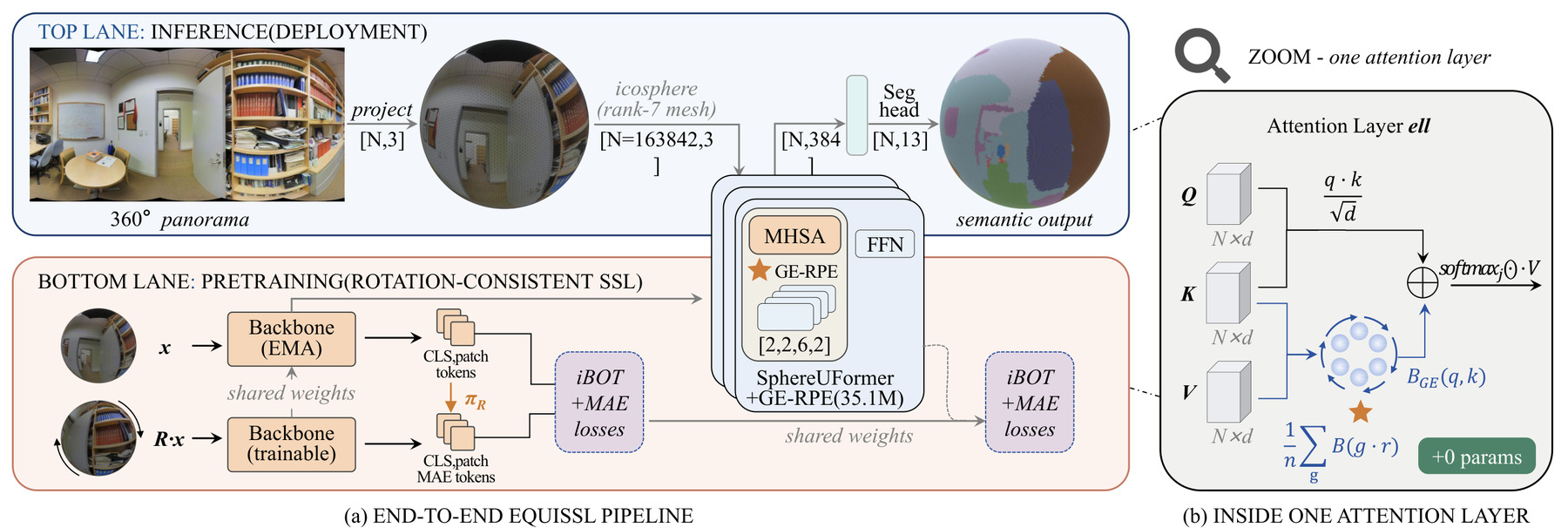
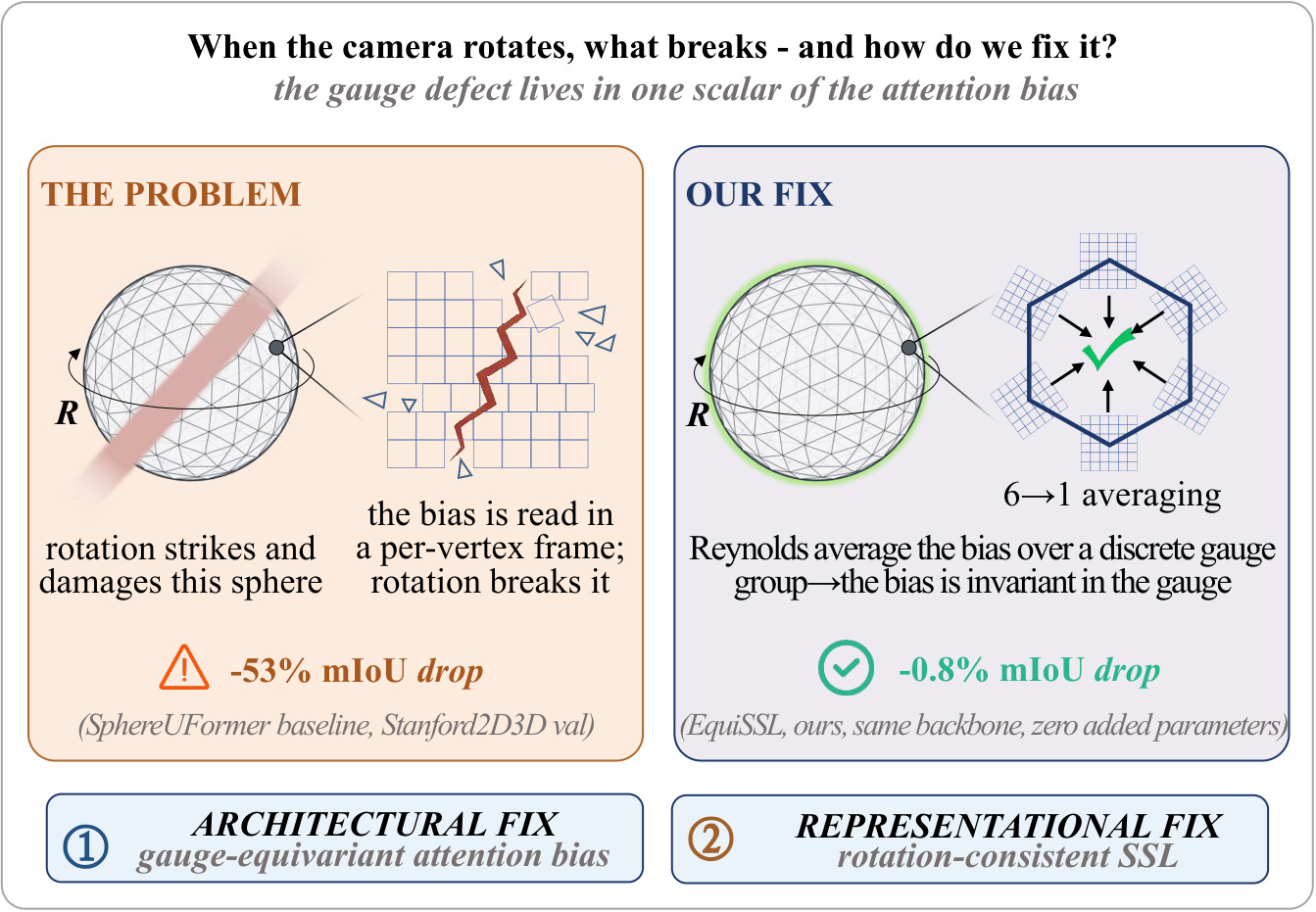
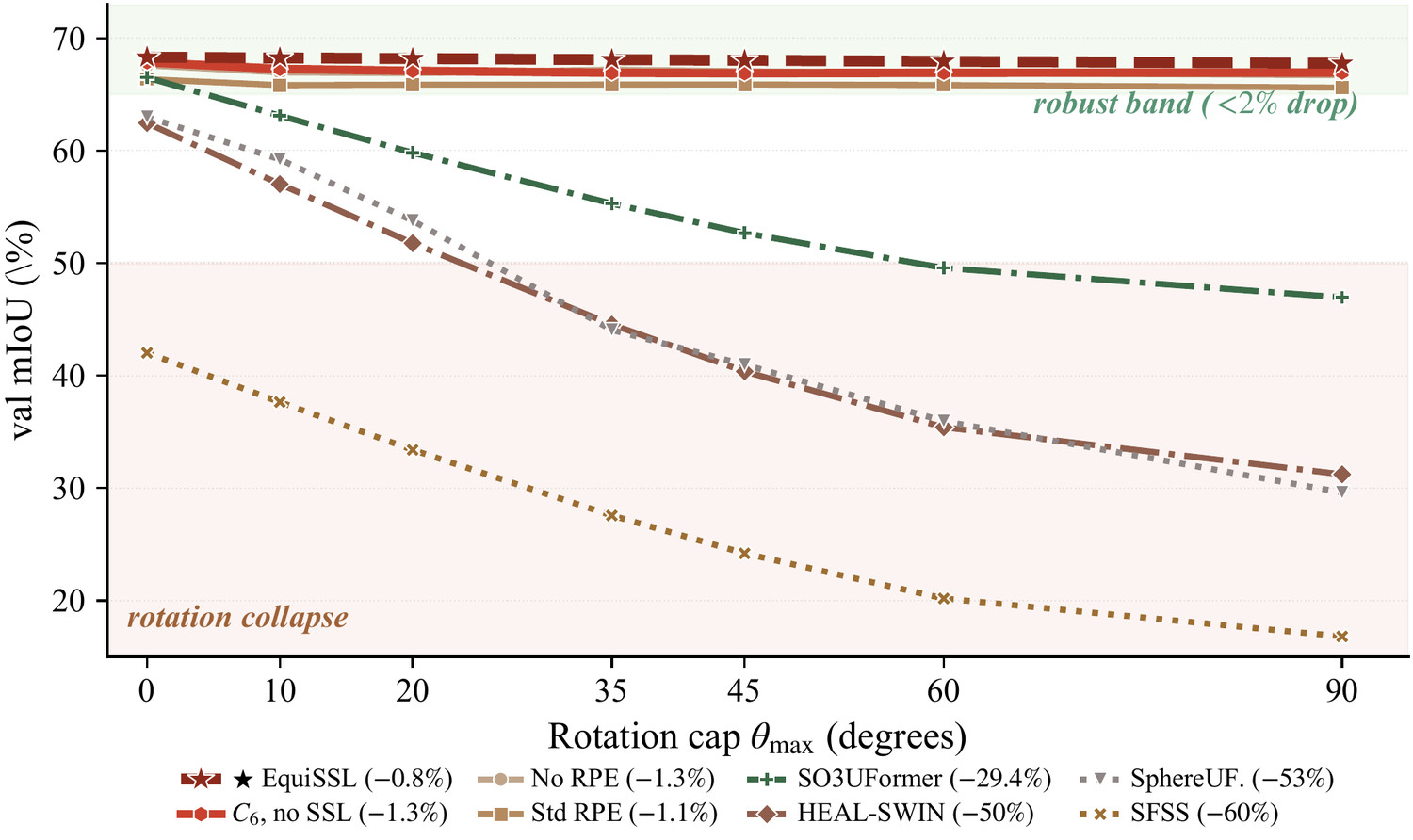
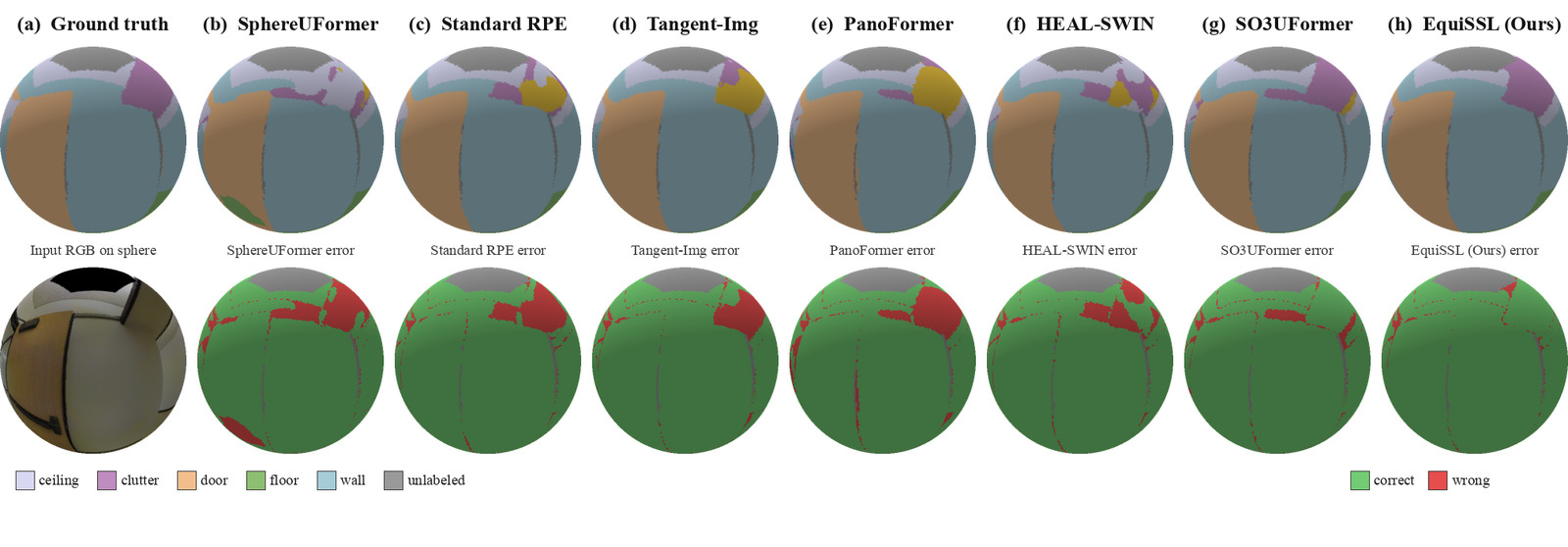
The claim is narrow and testable: with the backbone, data and training budget held fixed, a spherical transformer should be indifferent to camera rotation. On Stanford2D3D the drop falls from 53% to 0.8%, and the same representation transfers better under a 1% label budget.
我们的主张范围有限且可检验:在骨干网络、数据与训练预算固定时,球面 Transformer 应对相机旋转不敏感。在 Stanford2D3D 上,旋转导致的下降从 53% 降至 0.8%;同一表征在仅有 1% 标签时迁移效果也更好。
Case study 02 · Adaptation案例 02 · 高效适配
Adaptation without retraining. 无需重训的适配。
DAGA project pageDAGA 项目主页DAGA asks whether a frozen self-supervised ViT needs to be retrained at all. Its lightweight modules sit on every block, read the backbone's own attention maps, and generate channel and spatial gates that refine the frozen features; only 1.4% of the parameters are trained, and the backbone itself never changes. At comparable cost, it gives a better accuracy–parameter trade-off than adapters, LoRA or visual prompts.
DAGA 追问:冻结的自监督 ViT 是否还需要重新训练?轻量模块接入每个 Block,读取骨干自身的注意力图,生成通道门与空间门以细化冻结特征;只训练 1.4% 的参数,骨干本身始终不变。在相近成本下,它给出的精度—参数权衡优于 Adapter、LoRA 与视觉提示等方法。
Read on延伸阅读
The argument is in the papers. 论证在论文中。
Each direction above is carried by peer-reviewed work. The two case studies have their own project pages, and venues, DOIs and BibTeX are collected on the publications page. 以上每个方向都有同行评审论文支撑。两个案例各有项目主页;发表信息、DOI 与 BibTeX 均收录于论文页面。